Sometime in the 70s or 80s, some unsung hero came up with the idea of binding the edge of a rug to protect it from wear and tear, and boy, did it catch on. This brilliant innovation has done more for the longevity of hooked rugs than almost anything else. The earlier rugs tended to have folded-over hems, right next to the hooked edge. With wear and tear, those folded fibers typically become brittle and break, causing the rug to unravel. Binding the edge prevents the fibers from folding near the hooked area, thereby preventing the damage in the first place. This is by far the most common and most preventable source of damage on older rugs.

- Cut the extra linen, leaving a 3” selvege for the hem. Trim off the corners, leaving at least 1” from the hooked corner.
- Wrap the linen around a cotton cord (5/32”) beyond the hooked edge of the rug. With a regular needle and thread, tack the linen around the cord.
- When you get to a corner, continue to tack the linen down around both sides of the corner.
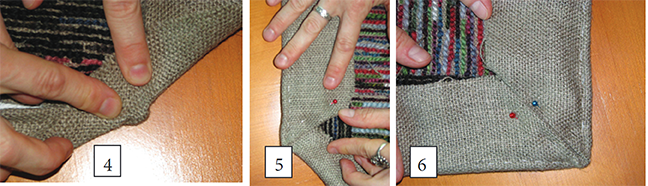
- After you have tacked the
linen down, turn the rug over and fold down the diagonal edge. - Tuck the raw edge under, and pin down one side of the linen.
- Do the same on the other side of the corner. Continue these steps all around the rug.
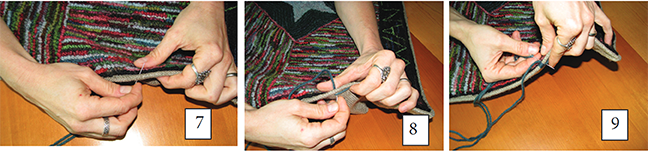
7. With an upholstery needle and matching yarn, come in from the back, leaving a 1” tail in back.
8. Come around with your needle through the back again, sewing over the tail in back. You don’t tie knots with the ends, you just sew over them.
9. Once you have established your stitching, turn the needle around. Instead of coming around again and coming up from the back, this time you will come in from the front to the back. Then keep whip-stitching front to back until you run out of yarn. Start again with a new piece of yarn, following steps 7-9, but this time, you’ll be sewing over two tails in back.
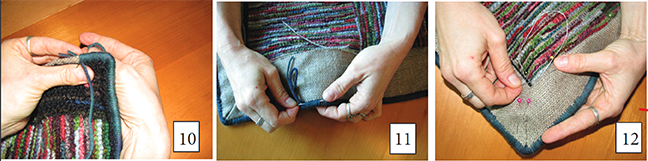
10. Whip-stitch around the corner so no linen shows through.
11. When you’ve whip-stitched around to where you started, put your needle through about 1” of stitching in back. then cut off the remaining yarn. Now all of your tails will be sewn over.
12. Hem with a regular needle and thread. Remember to stitch down the mitered corners as well. When you sew down the hem, make sure you’re taking deep stitches, connecting with the backing, not a strand of yarn.
A tendency to fray at the edges is sometimes seen in very old rugs. This may be guarded against by binding the edges of the rug with a cotton braid about one and a half inches wide with a diagonal weave. Care must be taken not to stretch the braid too taut or the rug will not lie evenly on the floor.
Elizabeth Waugh and Edith Foley, Collecting Hooked Rugs, 1927

Rose, 44”x74.” Hooked by Jean Volland Sullivan, 1953. Wool strips on burlap. Edge bound with twill tape.
Occasionally, you may come across an old rug that has been bound with hem tape. Dorothy Lawless, in her book, Rug Hooking and Braiding for Pleasure and Profit (1952) suggested that the cloth binding (twill tape) should be sewn onto the backing before hooking, then it is used to wrap around the remaining burlap:
Before starting to hook, one edge of the rug binding should be sewn along the edge of the pattern so that when the rug is hooked, the binding can be turned over the edge and basted along its unsewn edge on the underside of the rug with long blind stitches.

Lillian, 27”x45.” Wool fabric and yarn on burlap. 1920s. Edge bound with hem tape.
It’s a fine way to bind a rug, as long as you can get hem tape or twill tape in a color that matches the rug. They only come in a limited number of colors.
Generally, binding the rug with matching yarn is easier for me.
If you have an old hooked rug with a folded-under hem, you can often bind the edge to prevent damage from occuring in the future. As long as the folded edge is intact, you can unsew the hem, wrap the backing around a cord, and whip-stitch around it. Then you can sew down the rest of the hem as usual.
One of the things that distinguish Priscilla Turner rugs from other collectable antiques is that the factory had the rug hooker sign her name on the label. I have three Priscilla Turner rugs, two of which were hooked by Margaret Sampson, sometime in the 1970s.

The reason I know the time the rugs were hooked is because in researching the factory for Rug Hooker’s Guide to the YARNIVERSE! I found an archived newspaper article, a society column that wrote of Margaret Sampson’s birthday party. In attendance were a number of her co-workers from the rug factory. What a coup for rug collectors to be able to date their rugs from the party attendees!

Priscilla Turner Rug, 35””x58.” Wool yarn on cotton. Hooked by Margaret Sampson, 1970s.
Another Priscilla Turner rug that I own was quite a bit older than those Margaret Sampson ones, though. The label was an older design, and somewhat tattered. The ink on the signature line had long since faded away.
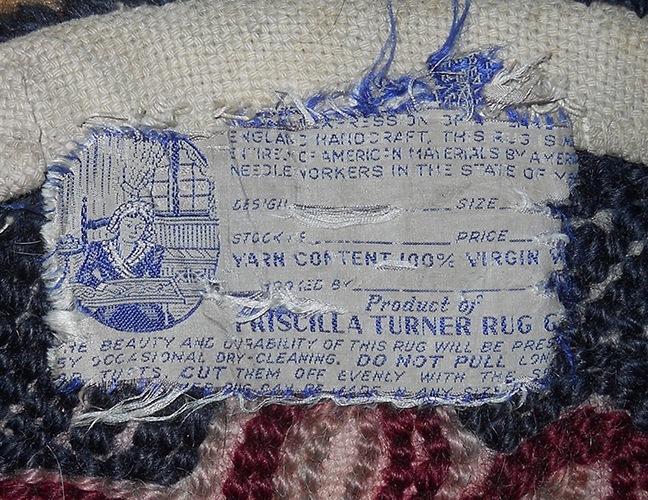
Still, the cotton backing was in good shape along the foldline, so I put in a bound edge to keep it looking good for many more decades to come.

I undid the hem and sewed it around the cording.

Here you see it with the new bound edge, to protect the backing from future wear and tear.

Old Priscilla Turner Rug, 23.5”x47.” Wool yarn on cotton. Edge bound to protect it from future damage.
Next Chapter: Out D#*&@ed Spot!
 Judy Taylor Books