The prettiest and newest way of using rags is to make them into rugs. These rag-carpet rugs are becoming quite the fashion again. They not only out-wear all others, but richer combinations of color, and more original ones can be obtained than in bought carpets generally. The ground for these is made of coarse canvas, known as “Burlaps,” such as is used for packing bags. The rugs are, many of them, really beautiful and command a good price.
Peterson’s Magazine, October 1876

From top to bottom: linen, Monk’s cloth, burlap
For the first two thirds of the 20th century, most of the rugs by far were hooked on a burlap backing. Burlap was cheap and easy to find. It’s not the most durable backing fabric, of course, but I figure if it wasn’t for the ubiquitous burlap, I doubt rug hooking would have survived to become the craft we know and love today. But it also means that we have a lot of lovely (shall we say mature) rugs in need of repair.
Sometime in the 1970s and 80s, better and more durable fabrics came on the market. Cotton monk’s cloth and rug warp, as well as linen were affordable alternatives to burlap for the average rug hooker.
Burlap is made from the jute plant, wonderfully biodegradable, which is why it is found wrapped around the root balls of shrubs in garden stores. Time and moisture will wear it away to nothing. Cotton is washable and more pleasant to work with than burlap, but as fibers go, it’s short and brittle. You don’t have to climb trees and dig in the garden to wear holes in a favorite pair of jeans. For my money, linen is the best backing for hooked rugs. It is strong, washable, and will outlast even the wool that is hooked through its durable threads.
And while a rug hooked on any kind of backing can require repair, by far the rugs that come my way were hooked on burlap.
To repair a hooked rug, you will sometimes need to cut a new piece of burlap or linen as a patch. Here’s a handy tip to make sure you are cutting the fabric on the grain. Whenever we wrap fabric around a bolt, it gets a little bit twisted, more with every wrap. That can cause the fabric to stretch along the bias (diagonally), which can result in uneven pattern markings and hooked edges. The fabric may look even along the cut edge, but it’s tricky to tell if it’s on the grain.
The best way to establish the grain is to find a strand of weft (the strands which go back and forth on the cloth, as opposed to the threads that go from one long end of the bolt to the other, that’s the warp). Pull on that weft thread until it is totally removed. Then cut the fabric along the gap that is left behind. When you line up the cut edge of the cloth now, you can be assured that you will have the fabric straight on the grain.
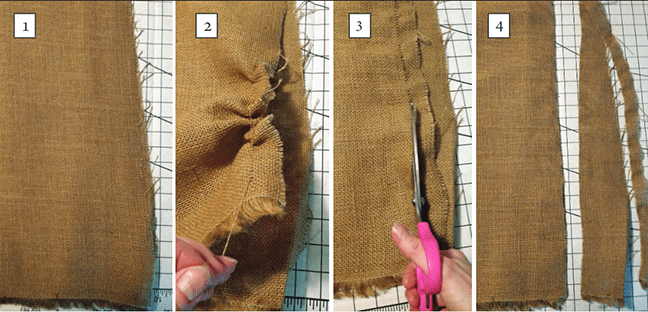
- The cut end of a bolt of burlap.
- Find a weft thread that is continuous from one edge of the fabric to the other edge. Pull the thread all the way out.
- Cut along the path left by the weft thread.
- Now the cut edge of the burlap is on the grain.
In his book, The Hooked Rug (1930), one of WW Kent’s correspondents, a Miss Anne Macbeth of Cumberland, Great Britain, wrote Kent in February, 1928:
All good housewives destroyed old rugs when they got grimy and no one seems to have any really old ones of any artistic value, none, that is to say, more than 150 years old, which does not count as very old here.

Mabel, 30”x46.” Hooked by Mabel Brooks, 1945. Wool fabric strips on burlap.
Early rugmakers hooked their work on backings of hand-woven linen and on old coffee, sugar and grain bags. Their hooking yarns were homespun or cut from old rags or clothing—whatever materials they could salvage for the purpose.
Dorothy Lawless, Rug Hooking and Braiding for Pleasure and Profit, 1952

Lion with Palm Trees, 67”x37,” wool yarn. Courtesy of Linda
Rosen Antiques. Notice the braided border, protecting the edge from wear and tear.
Next Chapter: Naughty Kitty
 Judy Taylor Books