Many of you know me as a rug hooker (www.littlehouserugs.com) and writer of books about the wonders of rug hooking.

But did you know I also write fiction? I have not been published in fiction yet, but it is my great love. I’m currently writing historical fiction and contemporary romance. I just attended the Pacific Northwest Writers Association annual conference, where I gave a talk on the subject of “How Screenwriting Helped My Novel.”
Here’s the gist: I took a class some years ago from screenwriter and novelist Kim Hornsby on how to write screenplay. Her very clever method of introducing us to screenwriting was to have us use something we’d already written, either a novel or a short story, where we knew the characters and the plot very well. We then used that project as a way to understand all the ins and outs of screenplay. I chose to use my contemporary romance, called Walking Over Wet Paint.
If you’ve written a novel, you may know that at some point, after you’ve workshopped it with your writing partners and revised the piece to the best of your ability, you might still wonder, “Is it done? Are the characters believable? Is the pacing okay?” That’s when you might need to consult a developmental editor. This takes a great deal of time and is understandably expensive. But screenwriters have a secret weapon, which they call “coverage.” In short, coverage is feedback on your screenplay. It’s cheap and fast, and boy did it make a difference in my novel!

As you can see above, this was my first critique of my screenplay. Notice that I received a “Pass” rating. There are three ratings; Pass (meaning ‘pass on this one,’ not ‘pass/fail’), Consider (meaning ‘has potential but needs work’), and Recommend (meaning ‘send it up to the decision-makers’). I also received a score of 3.5/10. Not surprising at all, my first time out. But I also received eight pages of written notes, which were so helpful, I went right back into my novel to address those points.
Now, when I say it was cheap and fast, here’s what I got. This first time I went for the Premium Coverage, where for $100, not only did I get notes on my screenplay, I also got a logline, an analysis of the script for budget and likely actors to play the parts, and a line-edit of my whole screenplay, pointing out all my rookie mistakes. All this in 72 hours.
You see, it takes months for a professional editor to read and analyze your novel and give advice, but it only takes 1.5 hours for a screen pro to read your script. And what novelist doesn’t want feedback on Plot, Characterization, Concept, Format, Voice, Structure and Dialogue? All the elements of a good story.
The whole thing was such a beneficial experience, I rewrote the screenplay and sent it in again for coverage.
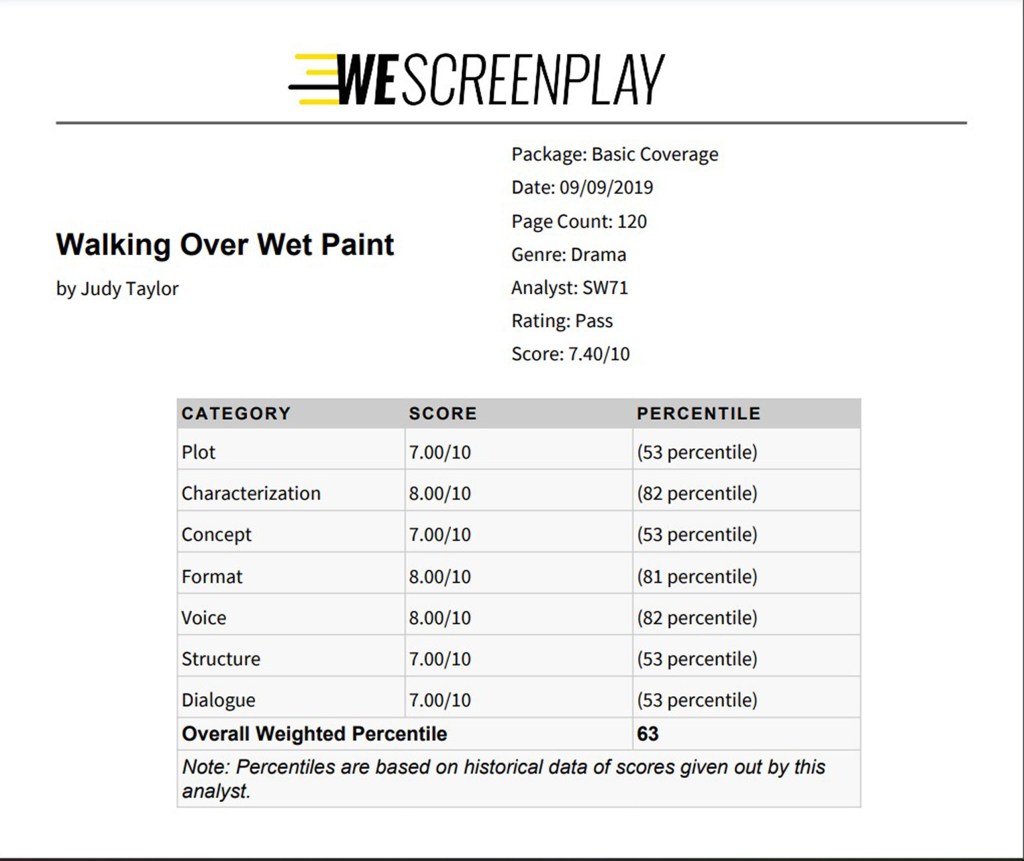
Still a Pass, but hey, I doubled my score! Again, I received six pages of written notes that I applied to my screenplay and my novel.
The next time I submitted my screenplay, I tried entering it as a Comedy instead of Drama. The thing is, it’s funny (and also heartbreaking, as any good romance should be) and it has a happy ending, so by the Greek definition, it was a comedy. Boy did that land flat with the next reviewer.

Ouch. A Pass and a score of 3.2/10. But the reviewer also gave me six pages advice on what he or she absolutely hated about my script, all of which was helpful to the novel and the screenplay. Maybe I’m a masochist, but I really love negative feedback. When someone says they like my writing, I have to admit to a tiny bit of disappointment, because I can’t use that praise to make my work better. This reviewer, whoever he, she, or they may be helped me to address some weak spots in my story, and helped me strengthen my characters. So I went back for more coverage.

This time, I went back to submitting the new draft as a Drama again, and looky there: I got a pretty good score and a Consider! As before, the six pages of notes were extremely helpful for improving my screenplay and my novel. So I went back at it again…
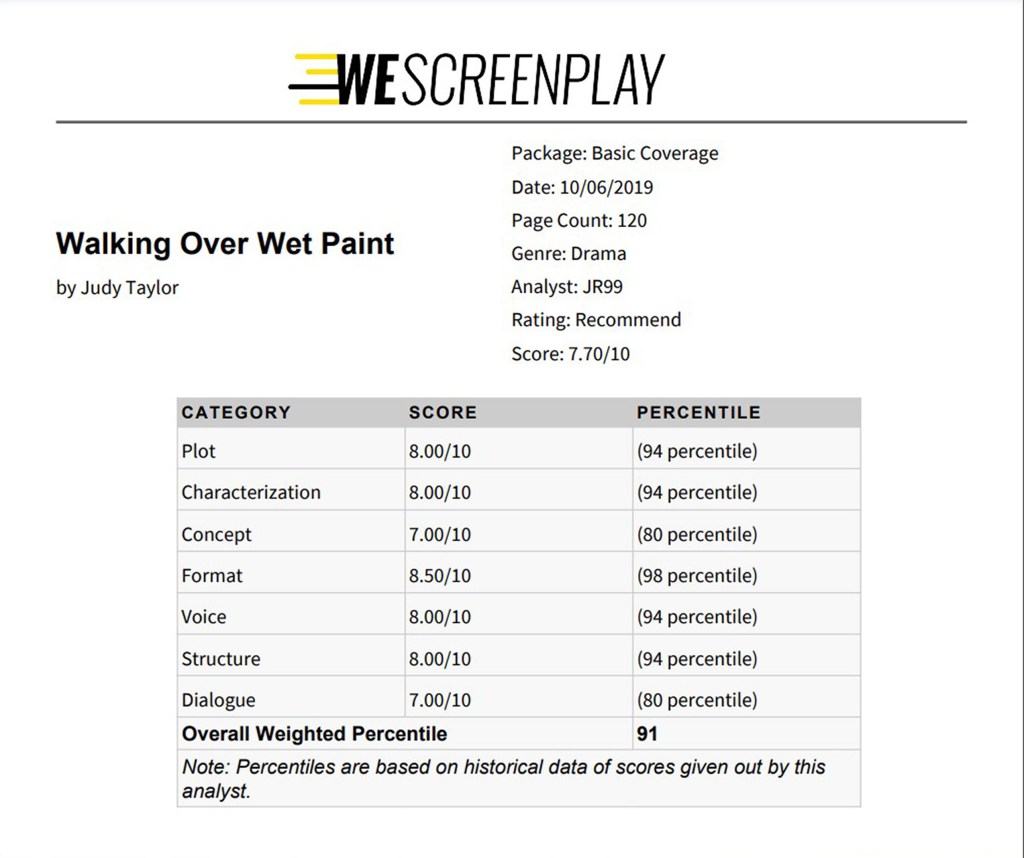
Ta daa! I got a 7.7/10 with a 91st percentile, and a RECOMMEND! Woo hoo! I wasn’t done, though. I still had to apply the 6 pages of notes to my screenplay and my novel.
The moral of the story? My screenplay won third place in the PNWA writing contest, and the book would have been a finalist in Women’s Fiction (except for the fact that I work for PNWA and am not eligible to win prizes) (hint, enter that contest for the critiques you receive!). I am also working on a stage play of the same novel.
Long story short, over a period of five months and a total of $380, I received what would have been a developmental edit of my novel, which would have cost me $3,000-$10,000! Yes, I did have to write a screenplay to take advantage of this shortcut, but that was something I did for fun anyway. I had no idea when I started the screenplay that it would benefit my novel, but it really helped.
Maybe it will help you, too? Let me know and I’ll trumpet your success!
Judy Taylor
http://www.judytaylorbooks.com


 Judy Taylor Books
Leave a comment