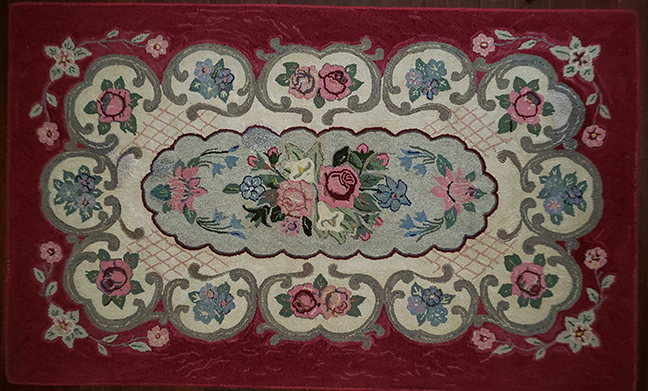
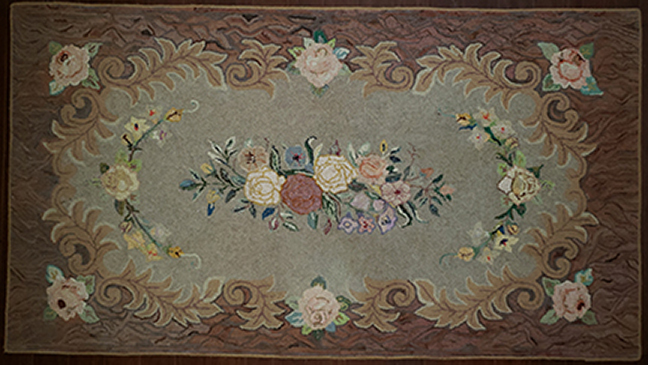
Amber, 38.5”x69.5.” Hooked by Jean Volland Sullivan, 1952. Wool strips on burlap.
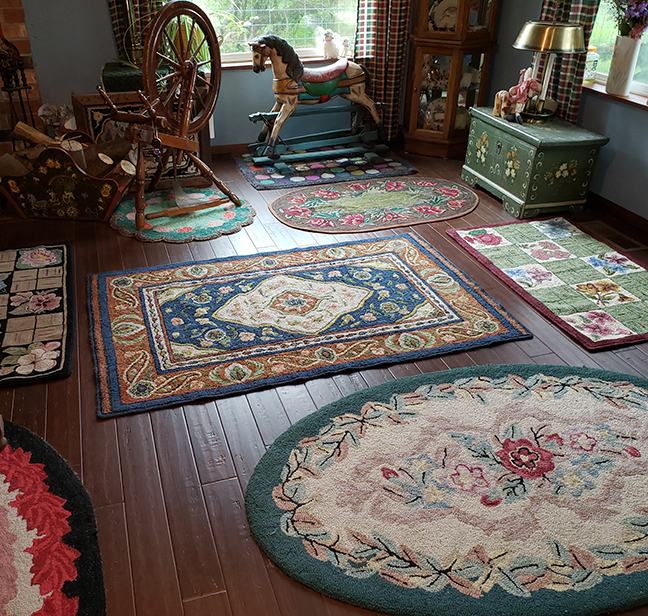
One of the most delightful things about antique hooked rugs is the safety with which we may submit them to their natural destiny. Their place is not in the showcase but on the floor. One has only to look at old specimens to know this is true. Hooked rugs were always made to use; most of them have come down to us after years of hard wear and often careless handling, and yet as a rule we find their hardy loveliness intact. Some, of course, show signs of wear, but they can usually be perfectly repaired; and, when this is done, they may again be spread with perfect confidence upon the floor.
Elizabeth Waugh and Edith Foley, Collecting Hooked Rugs, 1927
In my thirty-some years of rug hooking, I have come across my fair share of rugs in need of repair. Whenever I look at an old rug, I can’t help but wonder about the person who made it. For their sake, I want their rugs to be treasured. Over the years, I have developed a variety of techniques and strategies to resolve problems and return rugs to their place of pride, on the floor, to be enjoyed for decades to come.
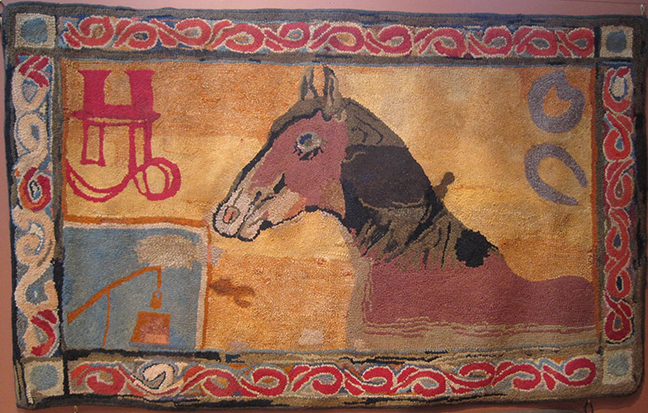
Smiling Horse, 61”x37.” Courtesy of Linda Rosen Antiques
They could not know the years of service which these rugs were going to give, because there was no precedent, nor could they foresee with what regard we would view their handicraft a century later.
Pearl McGown, The Dreams Beneath Design, 1949
My techniques are very basic and shouldn’t prove difficult for any experienced rug hooker to try. The tips and techniques in this book are derived from personal experience, as well as practical instruction from rug hooking books going back to the early 1900s. Just as rug hooking has evolved as a practical and enduring craft, so too have these basic repair techniques stood the test of time.

Grandma Guier’s Rug, designed and hooked by Julia Wicker Guier, 38”x38,” wool yarn, ca. late 1800s. Courtesy of Paula Bowden.
So often the rug makers of the nineteenth century used their gardens and fields and forests as designs for the pictures they painted with rags and a rug hook. Crude, some of them were, to be sure, while others were really lovely and worthy of being handed down as heirlooms and representations of an early American folk art.
Ella Shannon Bowles, Homespun Handicrafts, 1931
In this book, I’m not going to be talking about the preservation of museum-quality artifacts, but I will cover practical repairs of the everyday rugs we keep and enjoy. Let’s face it, when you put a rug on the floor, stuff will happen to it! It will get soiled, stained, snagged, moth-eaten, dog-chewed, cat-scratched and worn on the edges.

Dog chewed rug
One of the best things about hand-hooked rugs is that any rug hooker can fairly easily get in and repair the damage from decades of wear and tear.
You wouldn’t run a car for 50 or 60 years without a tune-up, right? Often, all it takes is a simple tune-up to keep our rugs looking great.
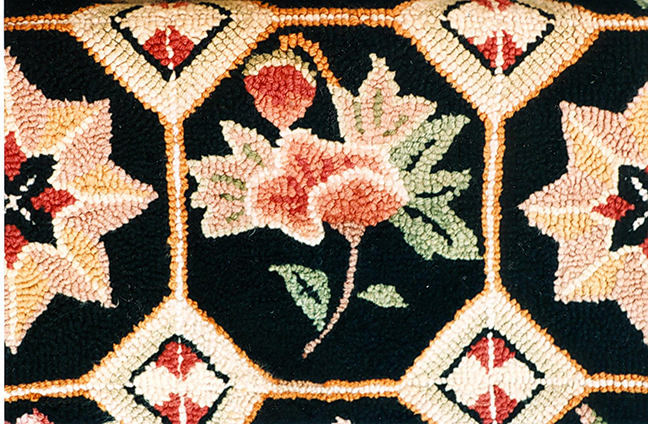
Same rug, repaired. Good as new!
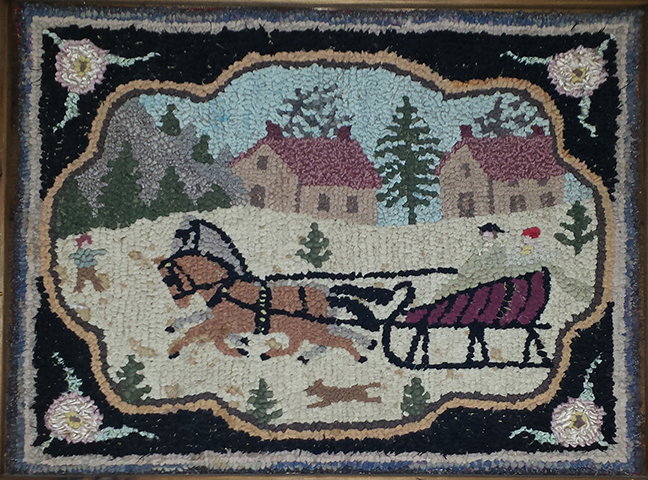
Sleigh, 24”x17.” Silk Stocking Rug, possibly 1930s
Most rug hookers today don’t sell their rugs. They make them for family or give them as gifts. They pursue rug hooking not for monetary gain, but for artistic expression and personal challenge. I hope to encourage some of those artists to consider rug repair as a business, applying their creativity and problem solving to help keep these treasures going. Let’s face it, the rugs we make today will outlive us, and I’d like to think that when my rugs get old, there will be someone around who knows how to fix them when I am long gone.
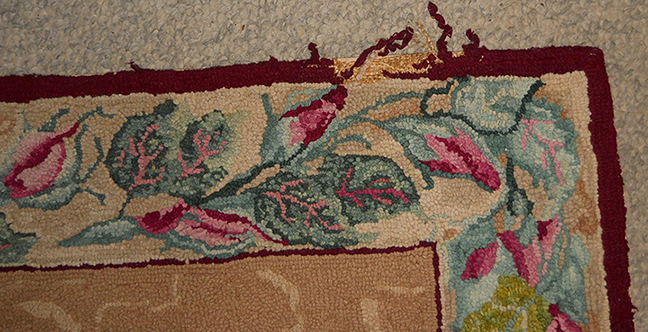
Damaged edge, before repair
In this book, I will cover basic care and cleaning, fixing stains, and repairing holes in the backing. I am also going to talk about refurbishing old rugs and finishing those unfinished treasures. Then a gallery of repair projects, each with their own unique problems and challenges and a primer on hooking with yarn.

After repair, with bound edge
Next Chapter: Telling A Good Yarn
 Judy Taylor Books